
Close
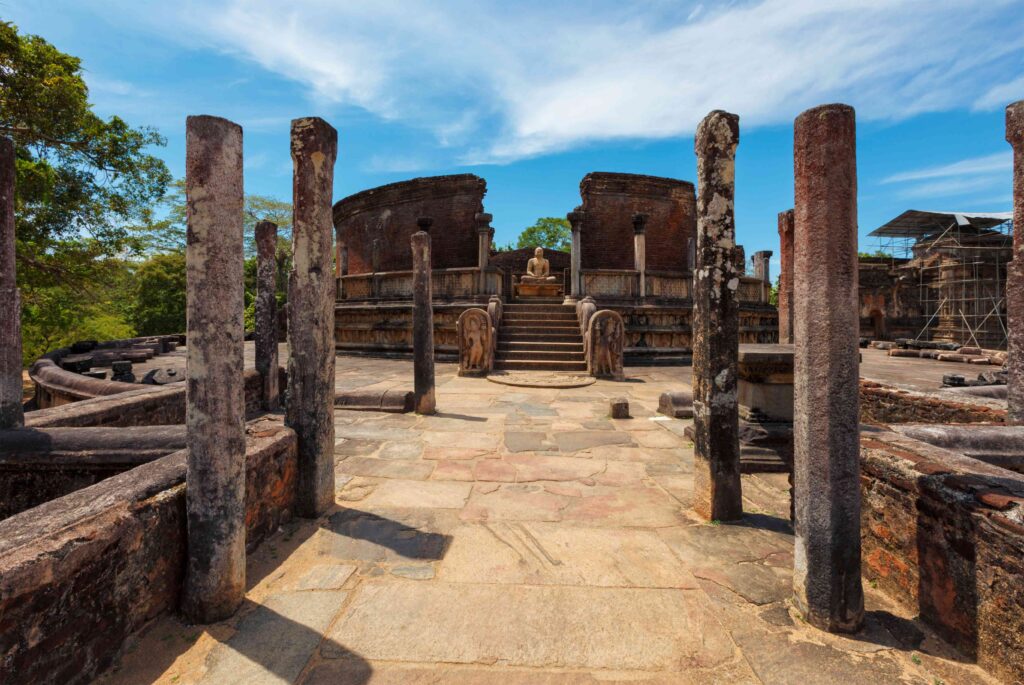
Polonnaruwa, located in the North Central Province of Sri Lanka, is the country’s second most ancient kingdom and a key component of its Cultural Triangle. After the decline of Anuradhapura in the 10th century, Polonnaruwa rose to prominence, becoming the capital of Sri Lanka from the 11th to the 13th centuries. Today, it stands as one of the best-preserved ancient cities in the world and is a designated UNESCO World Heritage Site.
The city’s history is marked by two distinct periods of rule. Initially, it was established as a military post and was later renamed by the Chola dynasty of South India after their invasion of Anuradhapura. However, the true glory of Polonnaruwa began with the Sinhalese kings, most notably King Parakramabahu I (1153–1186 CE), who transformed it into a magnificent, well-planned city. His reign is considered the “golden age” of Polonnaruwa, a period of great prosperity and architectural innovation. He constructed impressive palaces, gardens, and a colossal irrigation system, including the massive Parakrama Samudra (Sea of Parakrama), a man-made reservoir that provided water for agriculture and served as a defense moat.
The ruins of Polonnaruwa are spread over a large area, making it a perfect place to explore by bicycle. The site is compact and well-organized, with several distinct clusters of ruins.
The Royal Palace Complex: This is where the tour of the city often begins. The ruins of King Parakramabahu’s seven-story palace are a remarkable sight. While only the massive stone walls and a few pillars remain, they give a sense of the sheer scale and grandeur of the original structure. Nearby is the king’s audience hall, with its intricate stone carvings of elephants and lions.
The Quadrangle (Dalada Maluwa): This sacred area is a compact, elevated terrace containing some of the most concentrated and impressive ruins in Polonnaruwa. It was the original site of the Temple of the Tooth Relic and features several magnificent structures:
Vatadage: A beautiful circular relic house with four seated Buddha statues facing the cardinal directions. It is a masterpiece of ancient Sri Lankan architecture.
Atadage: The “House of the Eight Relics,” which once held the Tooth Relic.
Lankatilaka Vihara: A colossal, brick-built image house with towering walls and a headless standing Buddha statue. The building’s scale is awe-inspiring.
Gal Vihara: This is arguably the most famous site in Polonnaruwa. Gal Vihara, or the “Rock Temple,” is a group of four magnificent Buddha statues carved out of a single large slab of granite. They represent different postures of the Buddha: a seated Buddha in meditation, a smaller cave shrine with a seated Buddha, a standing statue, and a gigantic reclining Buddha, a masterpiece of ancient Sinhalese sculpture.
Rankoth Vehera: This is the largest stupa in Polonnaruwa, standing at 54 meters tall. Its distinct golden-brown color comes from the bricks used in its construction. It is an impressive sight and a significant pilgrimage site for Buddhists.
Kiri Vihara: A perfectly preserved white-plastered stupa, which owes its name (“Milk Stupa”) to the fact that its original white plaster has remained intact for centuries. It is believed to have been built by a queen of King Parakramabahu.
Pabalu Vehera: A cluster of small stupas and a central larger one, located near the main road. The name means “bead temple,” as many beads were found during excavations.
Tivanka Image House: Known for its beautifully preserved murals on the inside walls, though they are often faded. The name “Tivanka” refers to the triple-bent posture of the standing Buddha statue it contains.
Polonnaruwa’s strategic location near national parks like Minneriya and Kaudulla also makes it a popular starting point for elephant safaris, offering a unique blend of cultural heritage and wildlife experiences.

At RythmLanka Tours, we are passionate about turning your travel dreams into reality.
Our experienced team works closely with clients to deliver personalized travel plans, unique cultural experiences, and seamless journeys.